Competitive Battle Card Template: Win More Deals Against Competitors

Your rep is in a competitive deal. The prospect asks: "How are you different from Salesforce?"
If your rep stumbles, hesitates, or — worse — bad-mouths the competitor, you've lost.
Competitive battle cards fix this. But most battle cards are useless. They're either:
- Outdated the day they're created
- Generic "features vs. features" lists
- Too long to actually use
This guide gives you a battle card template that works — with free download.
What Makes a Battle Card Effective
| ❌ Bad Battle Card | ✅ Good Battle Card |
|---|---|
| 5-page PDF | One page, scannable |
| Feature comparison | Positioning for specific scenarios |
| Updated quarterly | Updated in real-time with AI |
| Generic talking points | Rep-specific scripts |
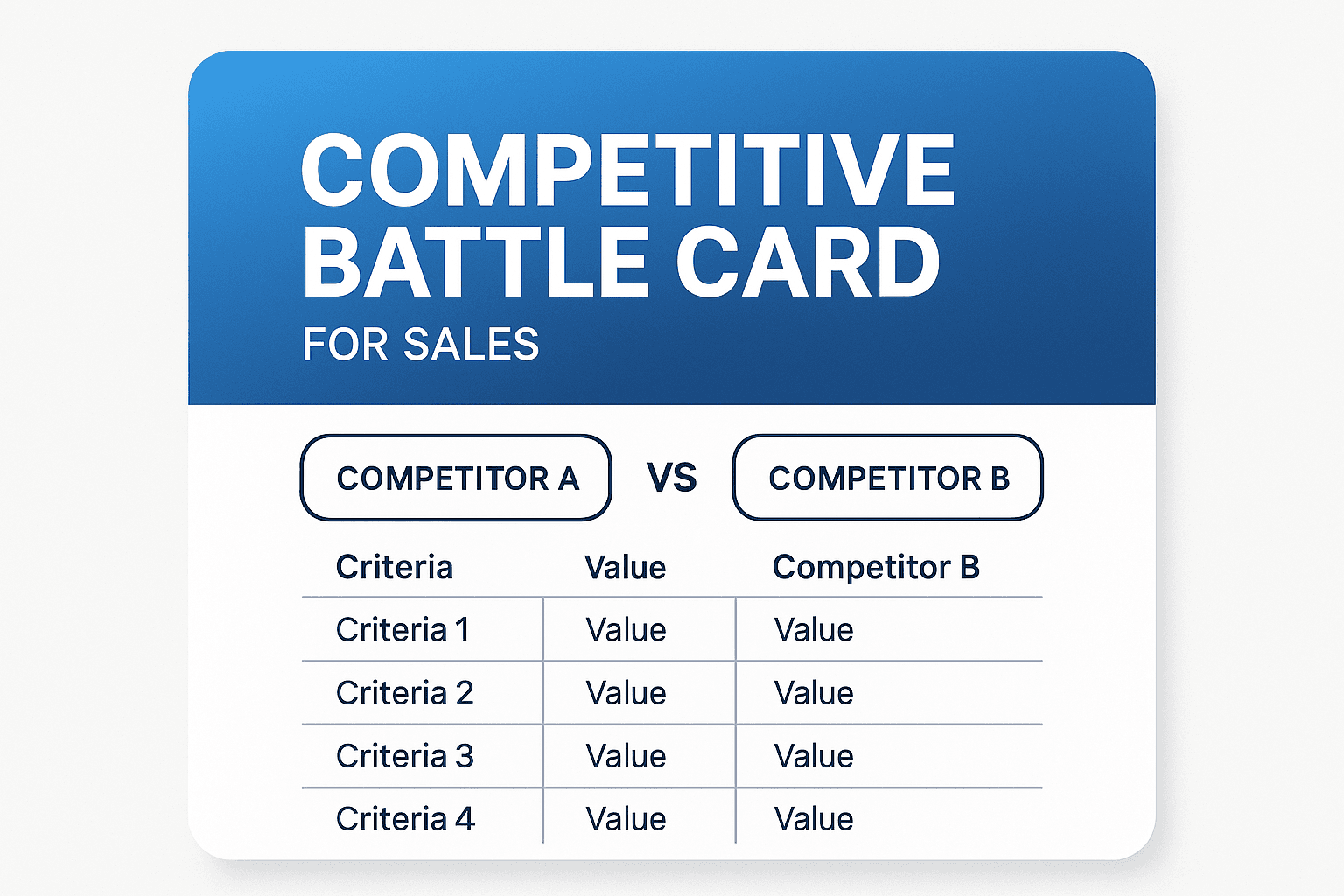
Free Battle Card Template Download
📥 Download Competitive Battle Card Template (PDF) →
Includes:
- One-page battle card layout
- Competitor profile template
- Positioning scripts
- Win/loss tracking
Battle Card Template Structure
Section 1: Quick Profile
| Field | What to Fill In |
|---|---|
| Competitor Name | |
| Market Position | Leader / Challenger / Niche |
| Typical Customer | Company size, industry |
| Pricing | Entry point vs. enterprise |
| Weaknesses | Top 3 customer complaints |
| Strengths | What they do well |
Section 2: Positioning Scripts
Opening Statement:
"You're looking at [Competitor]? That's a solid choice. Here's what I'd keep in mind: [their weakness]. That's actually why companies like yours switch to us."
Response to "They're cheaper":
"Yes, they are. And for some teams, that makes sense. But here's what I hear from customers who made that choice and then switched: [specific issue]. Is that a concern for you?"
Response to "We already use them":
"Great — you have a foundation. The question is: is it getting you to where you need to be? [Metric gap]. That's usually what prompts a re-evaluation."
Section 3: Landmines (Where They Leak)
| Competitor Weakness | Question to Ask |
|---|---|
| Complex implementation | "How long did your [Competitor] implementation take?" |
| Expensive add-ons | "What's your total [Competitor] cost now vs. when you started?" |
| Limited customization | "How flexible is [Competitor] for your specific workflow?" |
| Poor support | "What's your support experience been like?" |
| Feature bloat | "How many features do you actually use?" |
Section 4: Competitive Scenarios
| Scenario | Your Response |
|---|---|
| They're already using the competitor | See "We already use them" script above |
| Prospect loves the competitor | "What do you love most about it?" (then address gaps) |
| They're comparing 3+ vendors | Focus on #1 differentiator, not feature list |
| Decision is price-only | Reframe to total cost of ownership |
Battle Cards for Common Competitors
Vs. Salesforce
Their Strengths:
- Ecosystem/app marketplace
- Brand recognition
- Enterprise features
Their Weaknesses:
- Complex/expensive
- Slow to customize
- Requires admin support
Talk Track:
"Salesforce is great for enterprises with dedicated admins. But for companies wanting to move fast without a IT dependency, we hear that's a frustration. How important is flexibility to your team?"
Vs. HubSpot
Their Strengths:
- Free CRM foundation
- All-in-one marketing
- SMB friendly
Their Weaknesses:
- Limited enterprise features
- Pricing escalates quickly
- Sales tools not as deep
Talk Track:
"HubSpot is a great starting point. But most companies outgrow it on the sales side — specifically around automation and intelligence. When did you start hitting those limits?"
Vs. Copper (CRM for Google)
Their Strengths:
- Google integration
- Simple UX
- SMB focused
Their Weaknesses:
- Limited advanced features
- Google-only ecosystem
- Scaling challenges
Talk Track:
"Copper works well if you're all-in on Google. But as you add tools beyond the Google ecosystem, that simplicity becomes a limitation. How flexible does your tech stack need to be?"
How to Keep Battle Cards Updated
Traditional Approach (Manual)
- Quarterly review meetings
- Sales reps submit wins/losses
- Enablement updates cards
AI-Powered Approach (Recommended)
- Real-time win/loss analysis
- Automatic weak spot detection
- Dynamic script suggestions
See how RevWiser handles competitive intelligence →
Battle Card Best Practices
- One page max — If it's longer, no one reads it
- Update monthly — Outdated info is worse than no info
- Include scripts — Not just features, but what to SAY
- Track results — Mark which talking points work
- Make it accessible — Put in CRM, Slack, mobile app
Download Your Free Template
📥 Download Competitive Battle Card Template (PDF) →
Related Resources
RevWiser Team
Content writer at RevWiser, focusing on go-to-market strategies and sales enablement.